
➜ Marine Batteries
MARINE BATTERIES IN
Marine cranking amps are rated at 32 degrees Fahrenheit, so an MCA number always reads higher than the CCA stamped on the same case. Battery Power sells marine batteries in , minutes from the Harris Chain and the Tavares ramps, sized properly for starting and house duty. Licensed and insured, free on-the-spot load testing, every old core recycled free.
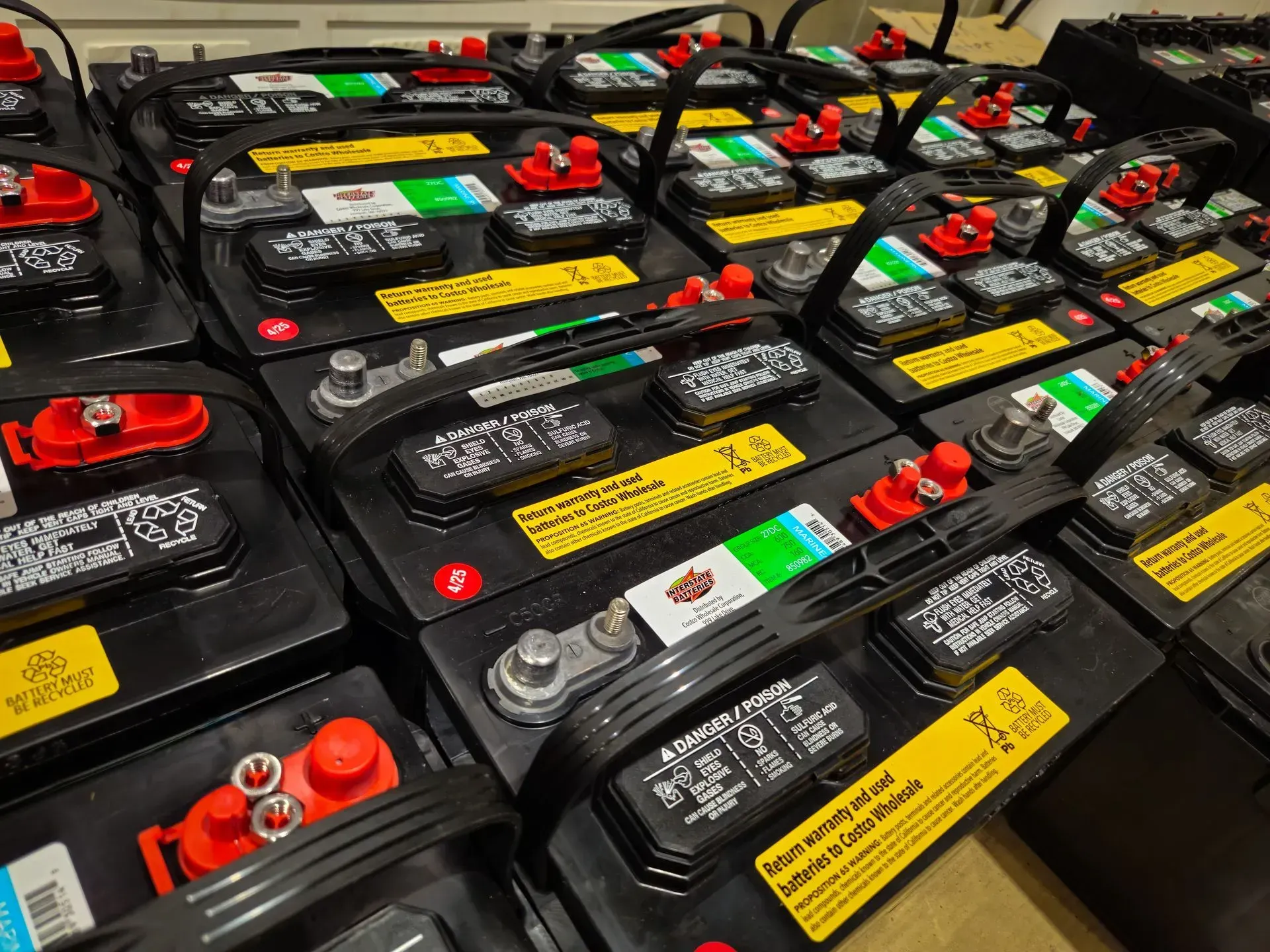
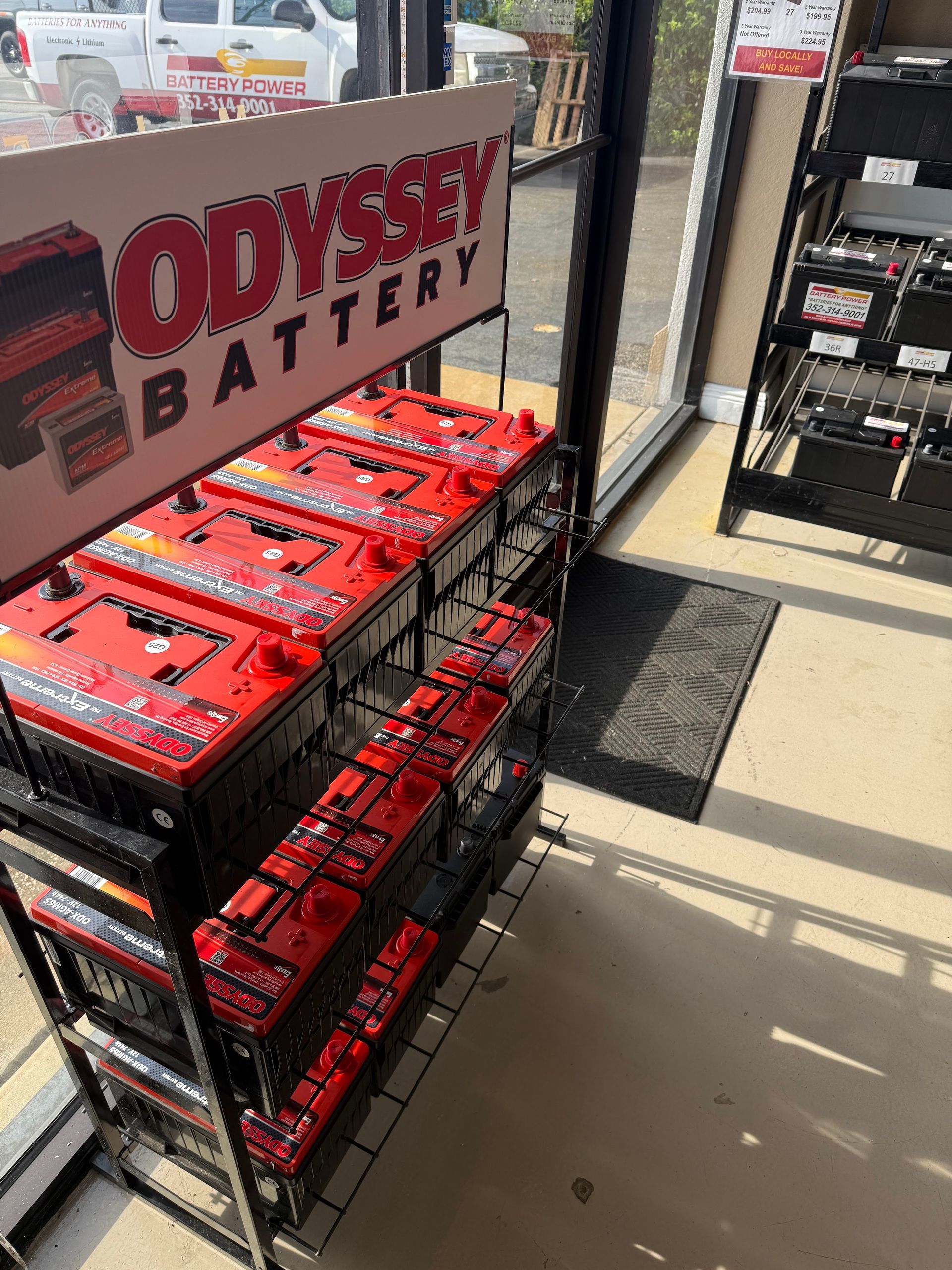
WEAK BANKS END TRIPS EARLY.
Nothing ruins a morning on the water faster than a bank that will not hold. A boat battery lives with heat, vibration, pounding chop and months of sitting between trips, and each of those shortens plate life. We see the same failures every spring: sulfated house banks and starting batteries that read fine at rest but collapse under load.
So we test under load before selling anything. A resting reading of 12.6 volts proves very little once a trolling motor or a cold outboard starts pulling real current from it.
- Starting and deep-cycle marine batteries in group 24, 27 and 31 cases
- Free load testing on every battery in your bank, not just the weak one
- Onboard charger checks, series and parallel wiring laid out correctly
- Terminal cleaning and corrosion protection before the boat leaves
➜ MARINE BATTERIES
STARTING BANKS AND HOUSE BANKS ARE DIFFERENT ANIMALS.
One battery delivers a huge burst for 3 seconds, the other trickles power out for 8 hours. Starting batteries use thin, numerous plates for surface area and high marine cranking amps. Deep-cycle marine batteries use thick plates that survive repeated discharge. A dual-purpose battery splits the difference on a small boat, and bigger rigs run both banks, wired through a selector switch we can help you plan and fuse.
THE HARRIS CHAIN SETS OUR STANDARD.
Connected lakes, big open water on Griffin and Eustis, and bass boats running long days out of Leesburg and Tavares. That mix asks for two things at once: enough MCA to fire a cold outboard, then hours of steady trolling motor draw in the heat. Boats here also sit through summer storms and humid storage, which is exactly when a neglected bank quietly dies.
HUMIDITY AND VIBRATION WROTE OUR CHECKLIST.
Salt is not our problem inland, but humidity, heat and constant pounding are. Since 2006 we have watched the same three things end marine batteries early: corroded terminals nobody protected, hold-downs that let the case walk around, and chargers left in the wrong mode. So we check all three before you leave, in-house, with no appointment needed. Why replace a battery the boat did not actually break?
why choose us?
Knowledgeable
Our knowledgeable team provides reliable battery solutions and helpful guidance to ensure you get the right battery for your specific needs.
Technical Expertise
With strong technical expertise, we have the skills and experience to handle custom battery packs, golf cart batteries, vehicle batteries, marine batteries, and power sport batteries.
Customer Satisfaction
Customer satisfaction is our priority, and we strive to deliver dependable service, quality workmanship, and a positive experience on every project.
Locally-Owned and Operated
As a locally-owned and operated battery company, we take pride in serving our local community with personalized service and dependable battery solutions.
➜ WHAT WE CARRY
OUR MARINE BATTERY RANGE
Every hull on this chain needs one of two things, or both at once. We carry starting and deep-cycle marine batteries in group 24, 27 and 31 cases, rated by marine cranking amps rather than guesswork.
STARTING
Group 24 Starting, 625 MCA
Compact and dependable, this 24M starting battery delivers 625 marine cranking amps for outboards and small inboards. The group 24 case fits most factory trays, and thin high-surface plates give the burst an engine needs.
HIGH OUTPUT
Group 24 Starting, 1000 MCA
Bigger outboards want more punch from the same footprint. Rated at 1000 MCA, this 24M starting battery suits high-compression engines, cold morning starts and boats loaded with electronics that draw current before the engine fires.
GROUP 27
Group 27 Starting, 1000 MCA
Stepping up to a group 27 case adds plate area and reserve behind the same 1000 marine cranking amps. Larger inboards, twin-engine rigs and cruisers with heavy accessory loads benefit from that extra headroom.
DEEP CYCLE
Group 24 Deep Cycle, 685 MCA
Thick plates change the job entirely. At 685 MCA this group 24 deep-cycle unit still cranks, yet it is built for hours of steady trolling motor draw and repeated discharge without losing capacity.
HOUSE
Group 27 Deep Cycle, 750 MCA
More amp-hours mean longer days. The group 27 deep-cycle battery at 750 MCA runs livewells, electronics, lights and a trolling motor through a full outing, then recovers overnight on a proper onboard charger.
TROLLING
Group 31 Deep Cycle, 840 MCA
Serious trolling motor banks start here. Rated 840 MCA in the largest common case, group 31 deep-cycle units wire in series for 24-volt and 36-volt systems and carry the most reserve of the range.
★★★★★
Excellent Service and Support
Exemplary service! Amicable, punctual, overall went well.
Chris K.
➜ THE WORD ON OUR WORK
WHAT OUR CLIENTS SAY.
Boaters tell us the same story after a season: the bank held, the terminals stayed clean, and nobody sold them more battery than the boat actually needed. Owner Eric Couture hears it most in spring, when covers come off and everyone learns what survived storage.
➜ Common Questions
FREQUENTLY ASKED QUESTIONS.
Here are the marine battery questions we hear across the counter every season, covering lifespan, sizing, charging, wiring and corrosion. Anything we missed, bring it in and ask.
How long do marine batteries last?
Plan on 3 to 4 years from a flooded marine battery in this climate, with AGM often lasting a little longer. Deep discharges, heat and storage at partial charge are what usually cut it short.
What is the difference between a group 24 and a group 27 marine battery?
Size and capacity. A group 27 case is longer than a group 24, holds more plate area, and delivers greater reserve, so it runs electronics and trolling motors noticeably longer between charges.
How do I stop marine battery terminals from corroding?
Clean the posts, tighten every connection, then coat them with dielectric grease or terminal protectant. Sealed AGM designs help, and keeping the battery compartment dry and ventilated stops most corrosion before it starts.
What voltage is a fully charged marine battery?
Around 12.6 to 12.7 volts at rest for a 12-volt lead-acid battery, measured hours after charging. Below 12.4 volts the bank is partly discharged, and 12.0 volts sits close to empty.
How deep can I discharge a deep-cycle marine battery?
Half capacity is the practical floor for lead-acid, since deeper cycles shorten life fast. Battery Power sizes house banks in Leesburg, FL so a normal day on the water never crosses that line.
Do boat batteries need to be secured in a box?
Yes. Marine standards require batteries fastened so they cannot shift, with the positive terminal covered against accidental shorts. A tray, strap or box also stops the vibration damage that kills plates early.
Can I leave an onboard charger plugged in all the time?
Modern multi-stage onboard chargers are designed for it and drop into a maintenance stage automatically. Older single-stage units are not, and leaving one connected for weeks boils off electrolyte and cooks the plates.
Why buy marine batteries from you?
Because we test the whole system, not just the battery. Battery Power has served boaters from Leesburg, FL since 2006, we check charger output and wiring, protect your terminals, and recycle old cores free.
➜ GET YOUR FREE MARINE BATTERY TEST
BRING THE BOAT BATTERIES IN, WE WILL TEST THEM, FREE.
No appointment and no charge, whether you pull one battery or the whole bank. We will load test each one, check your onboard charger, and tell you exactly which units are still good. Start on our contact page.
WHAT YOUR FREE BATTERY TEST COVERS:
- Resting voltage and state of charge on every battery
- Load test measured against the rated marine cranking amps
- Onboard charger output and stage behavior
- Series and parallel wiring, cable condition and fusing
- Terminal corrosion, hold-down and tray inspection
- Free recycling of every old marine core